
Blog  Vocaki
How to Build Your English Vocabulary in 10 Minutes a Day
On this page

Most people who want a bigger English vocabulary try to learn too much at once, get tired after a week and stop. The people who succeed usually do the opposite: a small amount, every day, for months. Here is how to build your vocabulary in ten minutes a day, and which words are worth those minutes.
How many words do you need?
You do not need to know every word in the dictionary. English is very uneven: a small number of words appear all the time, and most words are rare. Research by vocabulary experts such as Paul Nation suggests that the most common 2,000 to 3,000 word families cover the large majority of the words in everyday conversation, and that comfortable reading of books and news needs many more, around 8,000 to 9,000.
What this means for you:
- Start with high-frequency words. They pay off immediately in every conversation and text.
- Then learn the words of your goal. Exam words for IELTS or TOEIC, business words for work, travel words for a trip.
- Skip rare words for now. If you will not meet it again this month, it can wait.
The 10-minute routine
Do this once a day, at the same time if you can. Morning coffee, the bus ride, or right before bed all work.
Minutes 1 to 4: review
Start with the words that are due for review today. Try to recall each meaning before you look. This is the most important part of the routine, because new words are only useful if the old ones stay. If you are not sure why, read about spaced repetition.
Minutes 5 to 8: learn 5 to 10 new words
For each new word:
- Read the meaning and an example sentence.
- Listen to the pronunciation.
- Notice the words it usually goes with. You make a decision, you do not do a decision.
Five to ten new words a day sounds small. It adds up to 1,800 to 3,600 words a year, which is more than most courses teach.
Minutes 9 to 10: say and use
Say each new word out loud in a short sentence about your own life: "I need to make a decision about my job." Speaking forces you to put the word together yourself, and personal sentences are far easier to remember than textbook ones.
Keep the words in front of you
Ten focused minutes is the core, but you can add free practice during the day without opening anything. A vocabulary widget on your home screen or lock screen shows you a word every time you pick up your phone. Choose one that asks you to recall the meaning, like a flashcard or a quick quiz, rather than one that only displays a word.
What makes a good vocabulary builder app?
If you use an app, look for these:
- Spaced repetition, so it decides what to review and when.
- Active recall, so it asks before it tells.
- Audio and speaking practice, so you learn how the word sounds and how to say it.
- Words in context, with example sentences, not just translations.
- Word sets for your goal, from everyday words to exam vocabulary.
- Short daily sessions and a streak, so the habit is easy to keep.
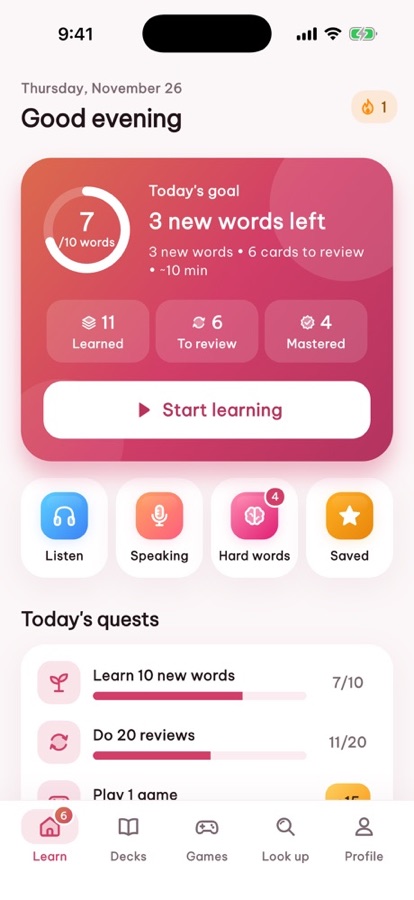
Vocaki was built around exactly this list: about ten minutes a day, FSRS spaced repetition, 9 exercise types, pronunciation practice, home screen and lock screen widgets, and no ads.
Stay consistent
Missing one day is fine. Missing a week is how habits die. Keep the routine small enough that you can do it on a bad day, and let the streak carry you through the days when you do not feel like studying.
More articles
 Vocaki
How to Add a Vocabulary Widget to Your Home Screen and Lock Screen
Step-by-step: add a vocabulary widget on iPhone and Android, pick the right style, and place it where you will actually see new English words every day.
 Vocaki
Spaced Repetition: How to Remember English Words for Good
Why you forget new English words within days, and how spaced repetition and active recall fix it. A simple review schedule you can start today.